
Basic Small Bird Care
Supporting physical and mental wellbeing
5
5
Choosing a cage
1
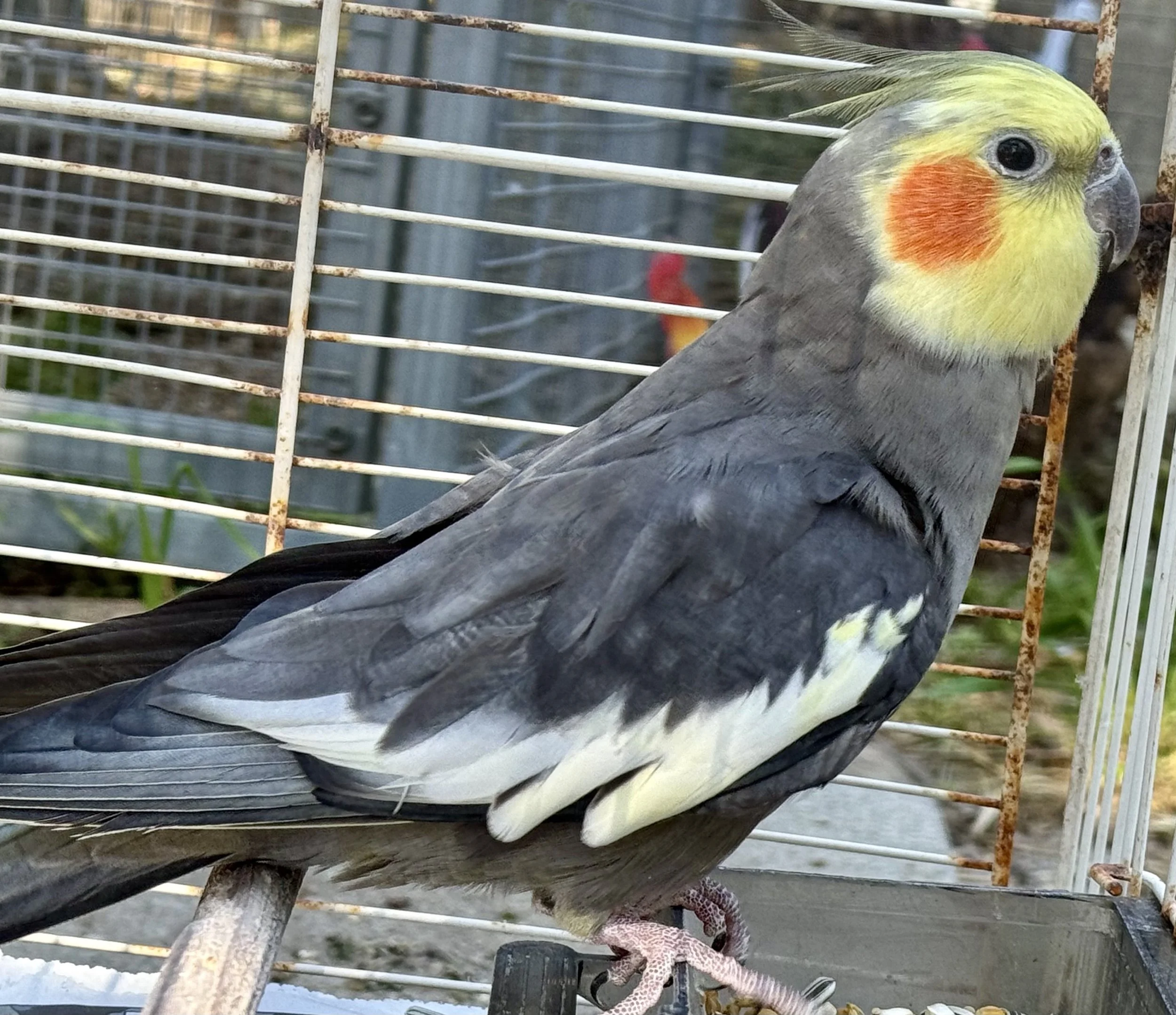
Budgies and other parrots fly across, not up and down, therefore they need a cage which is wider than it is tall. Finches and canaries fly much more than they climb, and need more space in order to do so. Most of the 'finch'/'canary' cages sold in pet shops are too small.
Cages should be rectangular. Round cages or any cage with decorative features (e.g. dome or triangular [roof shaped] tops) only limit any space a bird has available to fly in.
Round cages in particular have been shown to cause psychological distress.
The RSPCA guidelines for recommended minimum cage size a single budgie, specify the smallest is 45cm L, 45cm H, 45cm W (or 18").
However, this size should only be used if the budgie generally has free flight and only sleeps in the cage. We strongly recommend larger flight cages for any bird species.
Choosing perches
2
Plastic perches should be avoided as they can cause arthritis and other issues in bird feet. They also offer no help in trimming nails. Dowel perches are slightly better but still not preferable. A bird which only has dowel perches can often develop arthritis, inflammation, and/or pressure sores. Ideally, perches should be natural. A good rule to go by is the more texture and shape to the wood, the better for the bird.
Wing clipping
3
Unless there is a medical need for it which has been discussed with an avian vet, we don’t support wing clipping. It removes one of their biggest forms of defence/escape and limits their ability to exercise, increasing risk of muscle wastage and respiratory issues.
Feeding and nutrition
4
Companionship
A seed-only diet is nutritionally deficient in many areas, as well as being high in fat.
It is essential—and an indication of ethical breeding practice—that young birds are weaned on to a variety of fresh food as well as quality seed. This more easily sets them up for a healthy life. Birds weaned onto seed alone are less likely to recognise other foods as ‘safe’.
The Little Beaks flock enjoys a mix of quality seed and sprouts; fresh vegies; and fruit on occasion. We do not have lorikeets or other birds who require specialised diets. Check out our simple chop recipe.
Note: This is general dietary information and we are not qualified avian vets or nutritionists. This information is based on research, experience, and discussion with avian vets.
Some birds require different diets for medical or other reasons. Please consult an avian vet before changing your bird’s diet, or if you have any questions.
Birds are, by nature, flock animals and thrive in the company of their own species.
Keeping a bird alone increases the risk of loneliness, stress, and anxiety—particularly if their human family is away for much of the day. But the need for another bird goes far beyond simple ‘company’.
Why birds need their own species (beyond social companionship):
Behavioural regulation: Birds learn how to ‘be a bird’ from other birds, including preening patterns, vocalisations, body language, feeding behaviours, and appropriate stress responses.
Species-specific communication: Birds communicate through subtle posture shifts, feather movements, micro-vocalisations, and frequency ranges humans cannot replicate or fully interpret.
Mental stimulation: Mutual grooming, play, gentle squabbles, flock calls, and coordinated movement provide complex cognitive engagement that enrichment items alone cannot replace.
Stress regulation: In the wild, flock presence equals safety. Another bird nearby helps regulate baseline stress levels. A solitary bird may remain in a low-level state of alertness, even in a secure home.
Physical wellbeing: Allopreening (mutual grooming) supports feather condition, particularly around the head and neck where a bird cannot reach.
Emotional balance: Birds bonded only to humans can develop unhealthy attachment patterns, including separation distress, over-bonding to one person, hormonal frustration, or redirected aggression.
For flock animals, being alone isn’t simply ‘quiet’—it can affect neurological development, stress physiology, behaviour, and long-term welfare.
For most companion bird species, a companion of their own kind isn’t a luxury—it’s a fundamental need.
Enrichment
Our aviaries are completely naturally enriched, using native bird-safe foliage. The aviaries are placed over earth, which provides opportunity for foraging 24/7.
When considering accessories, natural is best. Leaves, nuts, bark, and other plant material allow birds to express curiosity and instinctual behaviours.
We strongly recommend avoiding the following:
Rope toys and perches: Birds can chew on and ingest fibres from these, which can lead to compaction/blockage, which is an emergency and can be fatal. See Currumbin Vet Services article on foreign body ingestion for more information.
Sandpaper sheets/perch covers: These provide little benefit and can be more dangerous for birds, potentially causing injury and infection. The rough sand on their flesh can lead to sores or conditions like bumblefoot.